Is Tesla's Unique AI Approach the Key to a $30 Billion Robotaxi Valuation?
Tesla, a company synonymous with electric vehicles and disruptive innovation, stands at the precipice of another transformative leap: fully autonomous driving. The pursuit of self-driving cars has become a modern-day space race, with numerous players vying for supremacy. Yet, some analysts suggest that Tesla's distinct approach to artificial intelligence, particularly its method of "solving autonomous driving like a video game," could be the differentiating factor that not only propels it to the forefront but also justifies a staggering $30 billion valuation specifically for its future robotaxi network. This isn't just about incremental improvements; it’s about a fundamental shift in how AI learns to navigate our complex world.
If such a valuation were added to Tesla's current market capitalization, it could translate to a significant boost for shareholders, potentially increasing the share price by approximately $160 based on 184 million shares outstanding. But what makes Tesla's strategy so compelling, and how does a "video game" philosophy translate into real-world autonomous capabilities?
The Autonomous Driving Triad: Perception, Prediction, and Planning
At its core, a self-driving car must master three fundamental capabilities to safely operate without human intervention:
1.
Perceive the Environment: The vehicle needs to accurately "see" and understand its surroundings – identifying other cars, pedestrians, traffic lights, road signs, lane markings, and obstacles.
2.
Predict the Future: Based on the perceived environment, the AI must anticipate the likely actions of other road users and the evolving dynamics of the scene. Will that pedestrian cross? Will the car in the next lane merge?
3.
Plan Actions: With perception and prediction in hand, the system must then formulate a safe, efficient, and compliant driving strategy – deciding when to accelerate, brake, turn, or change lanes.
Tesla's distinctive edge arguably lies in its advanced approach to these pillars, particularly in perception and planning. For perception, the company is deeply invested in
self-supervised learning on video. This ground-breaking technique allows neural networks to learn by predicting parts of a video frame or an entire video sequence from other parts. The profound advantage here is scalability: it enables the training of deep learning models on vast, "oceanic" amounts of unlabelled video data, unconstrained by the laborious and costly process of human hand-labelling. While hand-labelled datasets might still be used for fine-tuning, the heavy lifting of foundational learning comes from this automated, data-rich process. This ability to extract meaningful information from sheer volume of visual data is a game-changer.
From StarCraft II Master to Road Warrior: Tesla's Deep Learning Strategy
The most intriguing aspect of Tesla's strategy, and one that often draws both admiration and skepticism, is its application of deep learning to the critical task of *action planning*. Rather than relying on traditional, hand-coded rules and logic – an approach that quickly becomes unwieldy in the face of infinite real-world scenarios – Tesla is embracing deep learning methodologies like
imitation learning and
deep reinforcement learning. This is where the "video game" analogy truly comes into play.
Consider DeepMind's AlphaStar, an AI designed to play the notoriously complex real-time strategy game, StarCraft II. In 2019, AlphaStar achieved what many considered impossible, defeating Serral, the 2018 StarCraft world champion and one of the best players globally, in a series of matches. Online, AlphaStar consistently ranked among the top 200 players out of 125,000 competitors in Europe, outperforming over 99.8% of human players.
Why is this relevant to self-driving cars? StarCraft II is far more than just a game. It demands:
*
Strategic Foresight: Planning long-term objectives while adapting to immediate threats.
*
Tactical Execution: Managing multiple units simultaneously, often across different parts of the map.
*
Real-time Decision Making: Responding instantly to rapidly changing information.
*
Prediction and Adaptation: Anticipating opponent moves and adjusting strategies on the fly.
*
Immense Complexity: A vast state space with countless possible moves and counter-moves, requiring creativity and intricate problem-solving.
Many argue that the cognitive load and strategic complexity required for mastering StarCraft II significantly exceed that of everyday driving for a human. The ability of an AI like AlphaStar to learn, adapt, and consistently perform at such an elite level in an environment characterized by uncertainty and dynamic interactions directly mirrors the challenges of autonomous driving.
While some might dismiss the comparison as "just a game," the underlying principles of how AlphaStar learned – through vast amounts of data, reinforcement learning, and a deep understanding of cause-and-effect in a complex environment – are precisely what Tesla aims to leverage for its FSD (Full Self-Driving) system. This shifts the paradigm from programming a car with explicit rules for every conceivable situation to training a neural network that *learns to drive* by observing, simulating, and optimizing its actions, much like a human driver improves with experience. This approach holds immense promise for navigating the unpredictable nuances of real-world roads, a challenge that traditional rule-based systems struggle to overcome. To delve deeper into the AI strategies, explore
Unlocking Tesla FSD: Mastering Deep Learning for Real-World AI.
Laying the Groundwork: Tesla's Hardware Advantage and Future Prospects
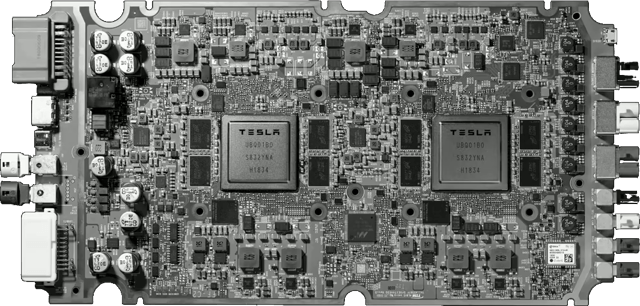
Tesla's foresight extends beyond its software approach. The company has proactively been equipping all new vehicles with an advanced suite of self-driving hardware, even before the software is fully mature enough to unleash its full potential. This "future-proofing" strategy means that millions of Tesla vehicles already on the road are outfitted with the necessary cameras, sensors, and computing power to handle future autonomous capabilities. This hardware suite, estimated to be worth around $8,000, is an optional add-on for buyers, ensuring that when the software "catches up," owners will be ready to unlock full autonomy with an over-the-air update, rather than needing a hardware upgrade.
This strategy offers several profound advantages:
*
Massive Data Collection: Every Tesla driving with this hardware collects valuable real-world data, feeding the neural networks and accelerating the learning process. This continuous feedback loop is critical for refining the AI.
*
Rapid Deployment: Once the software reaches regulatory approval for full autonomy, the existing fleet can be activated almost instantly, creating a robotaxi network on an unprecedented scale.
*
Strategic Cost Efficiency: Integrating the hardware during vehicle manufacturing is more efficient and cost-effective than retrofitting.
By having a vast network of autonomous-ready vehicles already deployed, Tesla significantly shortens the timeline for building out a functional robotaxi service. This eliminates the need to manufacture a separate fleet of purpose-built robotaxis from scratch, giving them a substantial head start over competitors. For more insights into this hardware strategy, read
Tesla's $8,000 FSD Hardware: Preparing for Autonomous Driving.
The Path to $30 Billion: Unlocking Robotaxi Value
The potential for a $30 billion valuation for Tesla's robotaxi division is not merely speculative; it's rooted in the profound economic and societal impact a successful robotaxi network could have. The advent of true self-driving capability, where vehicles can operate autonomously without human supervision, unlocks multiple lucrative revenue streams:
*
Robotaxi Network: Tesla owners could add their vehicles to a shared robotaxi fleet, generating income while their car would otherwise be idle. Tesla would take a percentage of these earnings, establishing a recurring revenue model similar to ride-sharing services but with significantly lower operational costs (no driver salaries).
*
Increased FSD Software Sales: As the capabilities of FSD improve and approach full autonomy, the perceived value of the FSD software package will skyrocket, driving more buyers to opt for the feature.
*
Logistics and Delivery: Beyond human transport, autonomous vehicles have immense potential in logistics and last-mile delivery, opening up new markets.
The market's perception of "tesla autonomous driving worth" will evolve in tandem with tangible progress. As Tesla demonstrates more consistent and robust autonomy, particularly with the release of new, rewritten versions of its Autopilot software, investor confidence will grow, and the market will begin to price in a higher expected value for these future capabilities. A functioning robotaxi service represents not just a new product but a paradigm shift in transportation, offering immense market potential by reducing car ownership costs, urban congestion, and enhancing personal mobility.
Conclusion
Tesla's pursuit of autonomous driving is ambitious, but its strategic pillars – pioneering self-supervised learning for perception, leveraging deep learning (akin to mastering complex video games) for action planning, and proactively integrating advanced hardware into its entire fleet – lay a credible foundation for its robotaxi aspirations. While the journey to Level 5 autonomy is challenging, the potential payoff is enormous. As the market gains clearer visibility into Tesla's progress, the $30 billion valuation for its robotaxi network may not just be a speculative figure but a realistic reflection of the transformative power of its unique AI-driven approach to solving one of humanity's grandest technological challenges. The race to full autonomy is heating up, and Tesla's video game-inspired AI might just be its ultimate winning strategy.