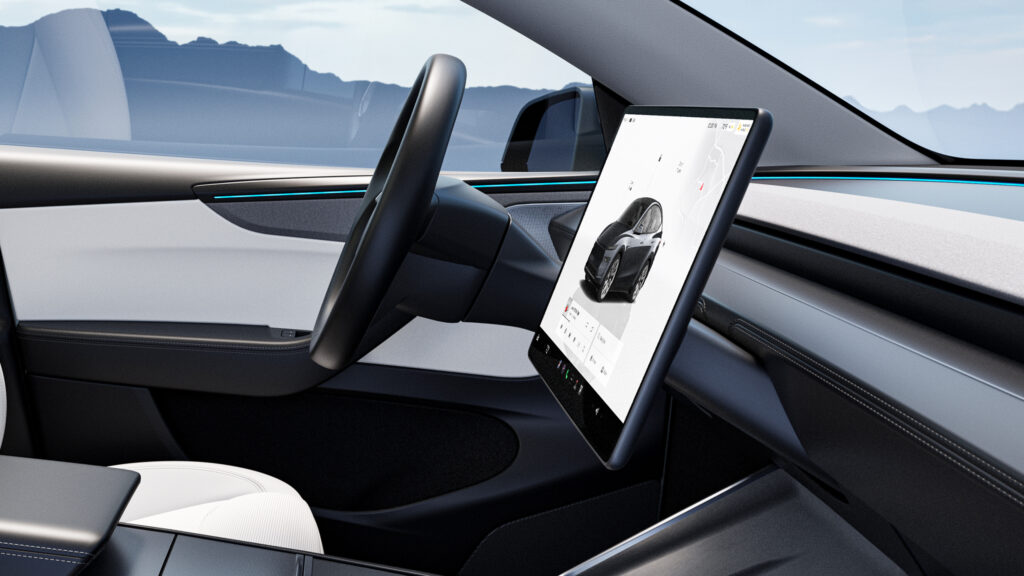
Tesla's $8,000 FSD Hardware: Investing in the Autonomous Future
The automotive world is on the cusp of a revolution, and at its forefront is Tesla, relentlessly pushing the boundaries of autonomous driving. With an optional $8,000 suite of Full Self-Driving (FSD) hardware, Tesla isn't just selling a feature; it's offering a ticket to a future where cars might drive themselves, transforming the very concept of vehicle ownership. This proactive investment in advanced hardware, even as the software continues its rapid development, speaks volumes about Tesla's long-term vision and raises a pivotal question for consumers and investors alike: what is this level of
tesla autonomous driving worth? Is it a gamble, or a visionary leap setting the stage for an unprecedented era of robotaxis and hands-free travel?
The Core Pillars of Autonomy: Perceive, Predict, Plan
Achieving true self-driving capability is an monumental engineering challenge, one that fundamentally boils down to three critical functions, mirroring how a human driver navigates the road:
1.
Perceiving the Environment: The vehicle must accurately "see" and understand its surroundings – other cars, pedestrians, traffic lights, road signs, lane markings, and unforeseen obstacles.
2.
Predicting the Future: Based on current observations, the car needs to anticipate the actions of other road users and potential changes in the environment. This involves understanding intentions and probabilities.
3.
Planning Actions: With perception and prediction in hand, the autonomous system must then devise a safe, efficient, and legal path forward, making real-time decisions on speed, steering, and braking.
Tesla's approach to mastering these pillars heavily relies on deep learning, particularly with an emphasis on video data. The biggest leap in perception, according to experts, is anticipated through
self-supervised learning on video. This groundbreaking technique allows neural networks to learn by predicting parts of a video frame or a sequence from other parts, effectively teaching themselves without requiring every single frame to be painstakingly hand-labeled by humans. This method offers unparalleled scalability, enabling the system to process "oceanic amounts" of unlabeled video data, which can then be fine-tuned with smaller, hand-labeled datasets. For planning actions, Tesla eschews rigid, hand-coded rules in favor of dynamic, deep learning approaches like imitation learning and deep reinforcement learning, offering a far more flexible and adaptable system capable of handling the inherent unpredictability of real-world driving.
Want to dive deeper into the AI strategies behind Tesla's FSD? Explore
Unlocking Tesla FSD: Mastering Deep Learning for Real-World AI.
From Video Games to Virtuoso Driving: The Power of Complex AI
To some, comparing the intricate task of driving to playing a video game might seem trivial. However, a closer look at advanced AI achievements in gaming reveals a profound parallel to the intelligence required for autonomous driving. Consider DeepMind's AlphaStar, an AI that conquered the notoriously complex real-time strategy game, StarCraft II. StarCraft II is often described as "chess to the power of ten," demanding not only strategic foresight but also lightning-fast reflexes, micromanagement of multiple units, and dynamic adaptation to an opponent's unpredictable moves.
In 2019, AlphaStar famously beat Serral, the 2018 StarCraft world champion, 4-1 in a series of casual matches. In subsequent online matches, AlphaStar surpassed over 99.8% of human players, ranking among the top 200 out of 125,000 competitors in Europe. This level of performance in a game requiring immense focus, strategic depth, and tactical creativity showcases AI's capacity to handle situations arguably as strategically and tactically complex as real-world driving. The intelligence and action-planning capabilities demonstrated by AlphaStar serve as a powerful testament to the type of cognitive skills deep learning can develop, directly transferable to the dynamic, multi-faceted challenge of navigating public roads. Dismissing this comparison as "silly" overlooks the serious application of AI learning in simulated environments that are critical to autonomous development.
The connection between gaming AI and real-world autonomy is more robust than it appears. Read more about it in
Is Tesla's 'Video Game' AI Key to a $30 Billion Robotaxi Value?.
Tesla's Proactive Move: The $8,000 FSD Hardware Investment
Tesla's decision to equip all new vehicles with an optional $8,000 suite of FSD hardware is a strategic play, acknowledging a fundamental truth: while the ultimate software for fully autonomous vehicles doesn't yet exist, the hardware needs to be ready when it does. Currently, no machine can perfectly replicate the human mind's ability to interpret, react, and make nuanced judgments in every conceivable driving scenario. Our capacity to see, understand, and intuitively react in real-time remains unmatched by computers.
However, Tesla's move is about future-proofing. By integrating the necessary sensors, cameras, and processing power upfront, Tesla ensures that when its sophisticated deep learning software finally "catches up" to the hardware's capabilities, owners will be immediately ready to unlock advanced autonomous features without requiring costly physical upgrades. This foresight minimizes friction for future adoption and maximizes the potential return on investment for early adopters.
Practical Insight: For prospective Tesla owners, the $8,000 FSD hardware package represents an investment in potential future functionality. While the full Level 5 autonomy promised by Elon Musk is still a work in progress, having the hardware ensures you're on the path. The current FSD Beta offers advanced driver assistance features, but the real value is tied to the future promise of a car that can truly drive itself, potentially even earning revenue as part of a robotaxi fleet. Weighing this against the immediate utility of existing features is key to determining its current "worth" for individual buyers.
The Future Value Proposition: Tesla's Autonomous Driving Worth
The implications of successful autonomous driving extend far beyond convenience. For Tesla, achieving full autonomy, especially through a widespread robotaxi network, represents an enormous potential revenue stream. Analysts suggest that a fully operational robotaxi service could add a staggering $30 billion to Tesla's market capitalization, translating to a significant increase in share price (potentially around $160 per share, based on older share counts). This valuation hinges on the belief that Tesla's unique approach to AI, leveraging real-world data and advanced deep learning, positions it uniquely to solve the self-driving puzzle.
For vehicle owners, the value proposition of
tesla autonomous driving worth could transform from a luxury feature into a powerful economic asset. Imagine a car that, when not in use by its owner, could generate income by operating as a robotaxi. This shifts the paradigm from a depreciating asset to a potential revenue generator, fundamentally changing the economics of car ownership. Even without a robotaxi network, the ability for a vehicle to navigate complex routes autonomously offers unprecedented levels of convenience, safety, and productivity for occupants, freeing up commute time for work, relaxation, or entertainment.
While the journey to full autonomy is undoubtedly complex and faces regulatory, technical, and social hurdles, Tesla's strategic deployment of the $8,000 FSD hardware suite underlines a deep commitment to this future. It signals confidence that their AI-first, data-driven approach will eventually crack the code. For those investing in a Tesla today, this hardware isn't just an optional extra; it's a down payment on a future that promises to redefine transportation as we know it, making the question of what
tesla autonomous driving worth truly is, a matter of billions.